One Language, Many Ways to Speak It
Imagine spending a few weeks learning Spanish in Antigua Guatemala. You begin ordering coffee in Spanish, chatting with your teacher, and understanding conversations at the local market.
But then a question comes to mind: Will the Spanish I learn in Guatemala also work in Spain, Mexico, Colombia, or Argentina?
**The answer is yes.**
Spanish is a language shared across many countries. Its fundamental grammar and much of its vocabulary provide a common foundation, even though pronunciation, expressions, and everyday words vary from region to region.
Guatemala offers an interesting example of this diversity. Its Spanish shares the essential structures of the language while reflecting the history, culture, and linguistic traditions of Central America.
And some characteristics of Guatemalan pronunciation have even attracted the attention of linguistic researchers.
So what makes Guatemalan Spanish different, and what will you learn when you study here?
Is Guatemalan Spanish Easy to Understand?
You may have heard people describe Guatemalan Spanish as clear or easy to understand. But is there any linguistic research behind that reputation?
One particularly interesting study comes from **Katrine Utgård**, whose research, *La pronunciación del español guatemalteco*, examined pronunciation patterns across 22 locations in Guatemala, including Antigua.
Her work documents regional pronunciation characteristics, including how consonants such as the Spanish *s* are pronounced in different parts of the country.
Utgård also discusses earlier observations by linguist **D. Lincoln Canfield** about the articulation of the *s* sound in Guatemalan Spanish.
This is interesting because the pronunciation of *s* varies throughout the Spanish-speaking world.
In some varieties, particularly in parts of the Caribbean and southern Spain, an *s* at the end of a syllable may be softened, aspirated, or omitted. In many Guatemalan speech patterns, this consonant is maintained, although regional variation also exists.
For a student, hearing these sounds distinctly may make it easier to recognize certain word endings, including plural forms such as *casas*, *amigos*, and *estudiantes*.
However, linguistic research does not establish that Guatemalan Spanish is universally clearer or easier to learn than other varieties.
What it demonstrates is that Guatemala has identifiable pronunciation characteristics that make its Spanish an interesting subject of study and a valuable part of the language-learning experience.
Guatemalan Spanish vs. Spain Spanish: What's Different?
One of the most recognizable differences between the Spanish spoken in Guatemala and much of Spain involves the pronunciation of the letters *c* and *z*.
According to the **Royal Spanish Academy (RAE)** and the **Association of Academies of the Spanish Language (ASALE)**, most Spanish speakers in the Americas use a pronunciation pattern called *seseo*.
This means that *s*, *z*, and *c* before *e* or *i* share the same pronunciation.
For example, in Guatemala:
- *Gracias* uses the sound of *s*. - *Zapato* begins with an *s* sound. - *Cerveza* uses that same sound for both *c* and *z*.
In much of central and northern Spain, speakers distinguish between the *s* sound and the sound of *z* or *c* before *e* and *i*, which resembles the English *th* in *think*.
However, this distinction is not universal in Spain. The Canary Islands and parts of Andalusia also use seseo.
Neither pronunciation is more correct than the other. Both are recognized characteristics of the Spanish language.
For students learning in Guatemala, seseo provides exposure to a pronunciation pattern shared across most of Latin America.
Tú, Vos, and Usted: Three Ways to Say "You"
Imagine greeting someone in Antigua with *¿Cómo estás?* — How are you?
Later, you might hear someone say *¿Cómo estás vos?* or *¿Cómo está usted?*
All three forms can be natural in Guatemala, depending on the relationship between speakers and the social context.
The **RAE's Diccionario panhispánico de dudas** identifies Guatemala as one of the Central American countries where *voseo*, the use of *vos*, is widespread.
Consider these examples:
- **Tú hablas español.** A familiar form widely used internationally. - **Vos hablás español.** A common informal form in Guatemala. - **Usted habla español.** Often associated with respect or formality, although it can also be used in other social contexts.
In Argentina, *vos* is also common. In much of Mexico, *tú* is more frequently used in familiar conversations.
In much of Spain, people use *vosotros* to address groups informally, while in Guatemala and most of Latin America, *ustedes* is the usual plural form.
Learning these differences helps students understand not only grammar but also how language expresses familiarity, courtesy, and relationships.
At Spanish Antigua, students can learn internationally useful grammatical structures while becoming familiar with the forms they hear in everyday Guatemalan conversations.
Different Words, Shared Meanings
The Spanish you learn in Guatemala will be useful in other countries, but you will occasionally encounter different words for familiar things.
For example, in Guatemala, someone might say *carro* when referring to a car. In Spain, *coche* is more common.
Other examples include:
**Car:** *Carro* in Guatemala; *coche* in Spain.
**Computer:** *Computadora* in Guatemala; *ordenador* in Spain.
**Cell phone:** *Celular* in Guatemala; *móvil* in Spain.
**Juice:** *Jugo* in Guatemala; *zumo* in Spain.
**Potato:** *Papa* in Guatemala; *patata* in Spain.
These are common regional preferences, not absolute rules. Many words are understood beyond the countries where they are most frequently used.
Guatemala also has expressions that reflect its local identity.
*Chapín* or *chapina* is a widely recognized term for a Guatemalan person, while *chilero* is a colloquial expression used to describe something enjoyable, attractive, or excellent.
The **ASALE Diccionario de americanismos** documents these and many other regional expressions.
Learning local vocabulary adds another dimension to the experience, but students do not need to memorize every regional variation before they can communicate.
A strong foundation in Spanish makes it easier to recognize and gradually incorporate new vocabulary wherever you travel.
A Language Shaped by Guatemala's Cultural Heritage
Guatemala's linguistic history is particularly rich because Spanish exists alongside numerous Indigenous languages, including K'iche', Kaqchikel, and Tz'utujil.
These languages remain an important part of the country's cultural identity and everyday life.
Their historical contact with Spanish has also attracted academic attention.
In her study *Contacto de lenguas en Guatemala*, linguist **Ana Isabel García** examined Spanish spoken in communities where the Mayan language Tz'utujil is also used.
Her research documents changes in certain Spanish pronoun patterns associated with prolonged language contact.
This does not mean that everyone in Guatemala speaks Spanish in the same way. Rather, it highlights the country's linguistic diversity and the influence of different communities on regional forms of Spanish.
For visitors and language students, Guatemala offers an opportunity to appreciate that diversity while developing their own communication skills.
Learning Spanish here is not only about grammar and vocabulary. It can also open the door to a deeper understanding of the people, traditions, and cultures that give the language meaning.
What Kind of Spanish Will You Learn at Spanish Antigua?
At **Spanish Antigua**, we teach Spanish as a practical language for everyday communication, with a grammatical foundation that students can use throughout the Spanish-speaking world.
Our school was established in 1978 in Antigua Guatemala, and our teaching approach emphasizes personalized instruction and meaningful conversation.
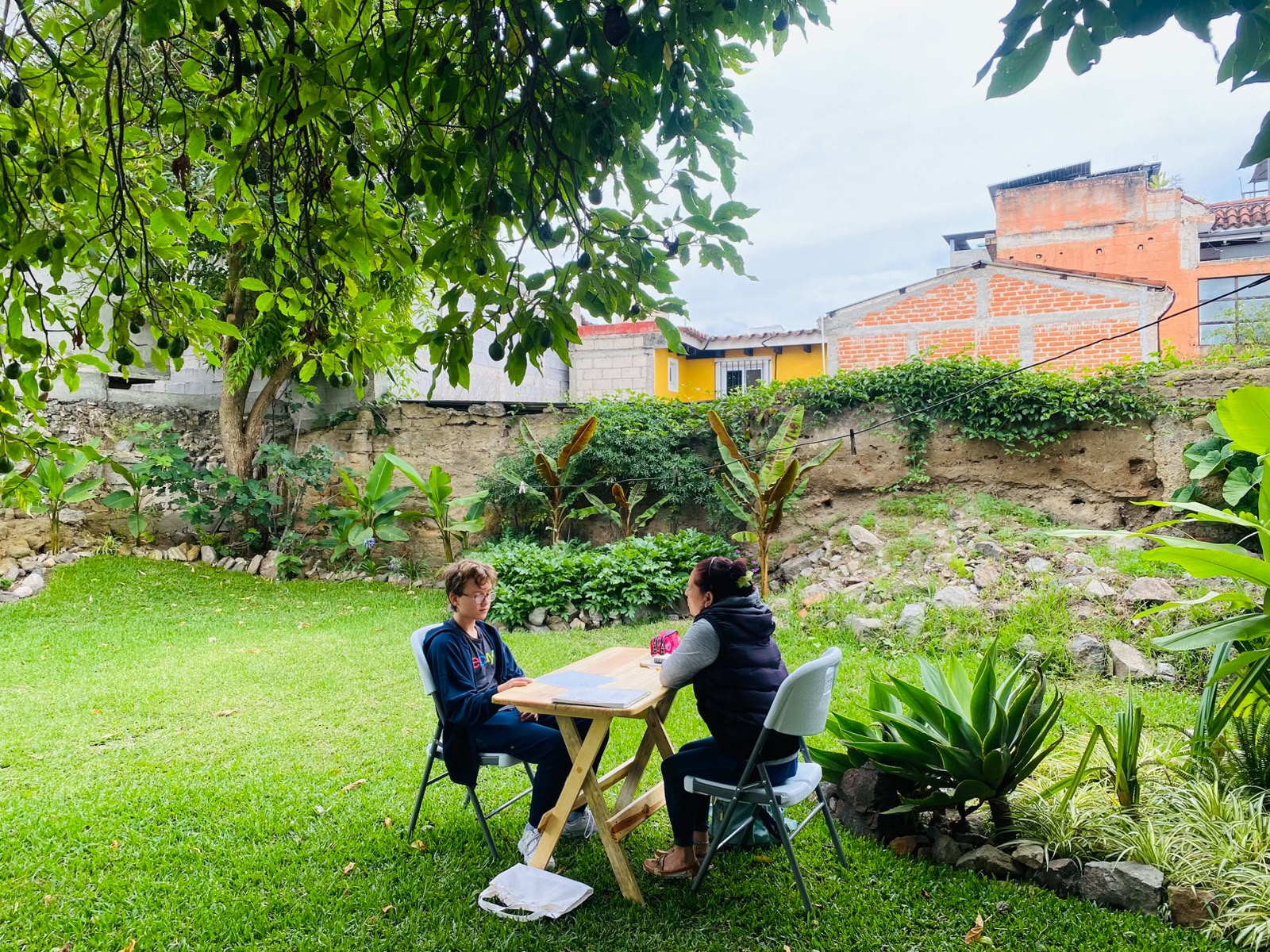
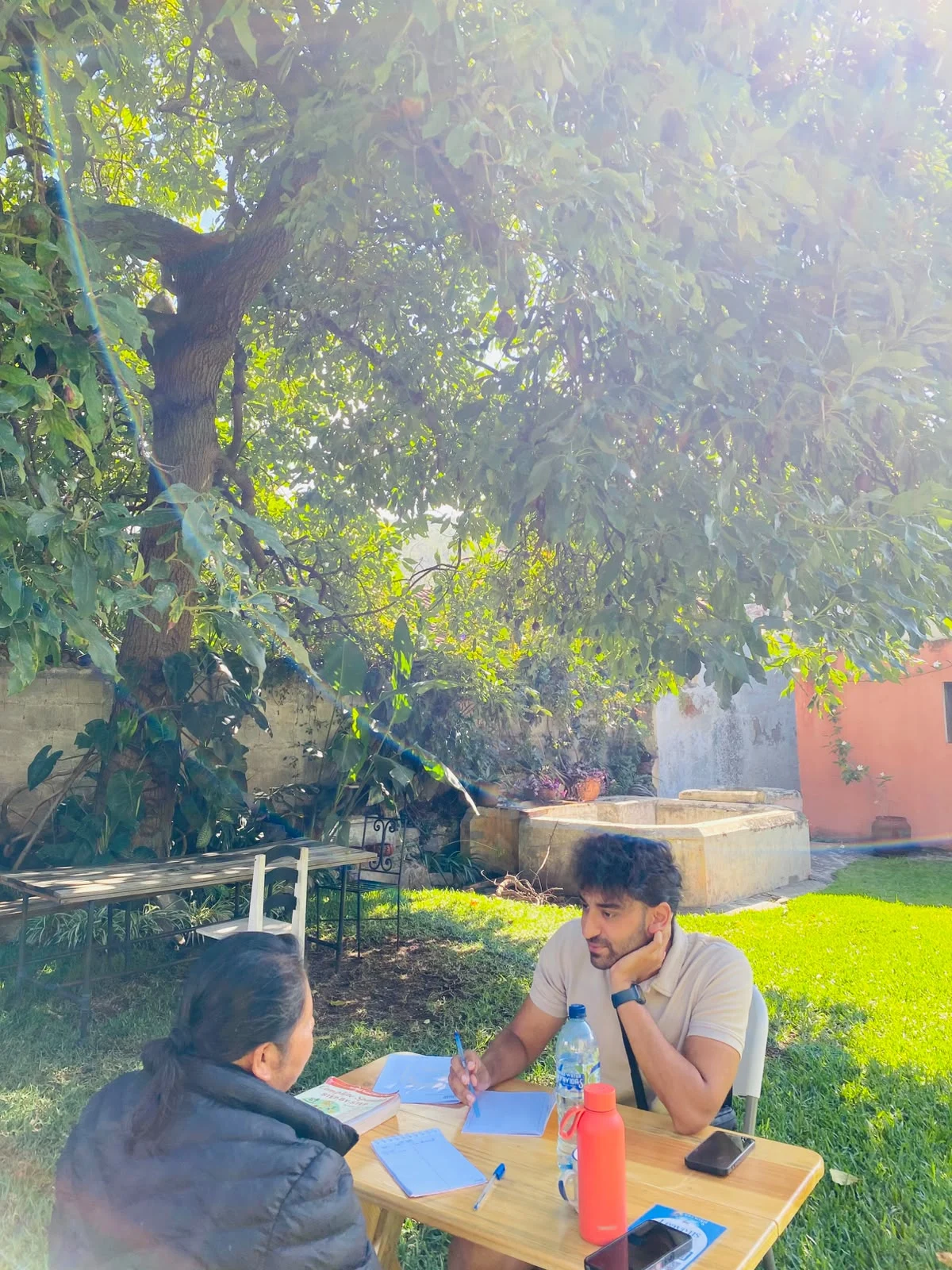
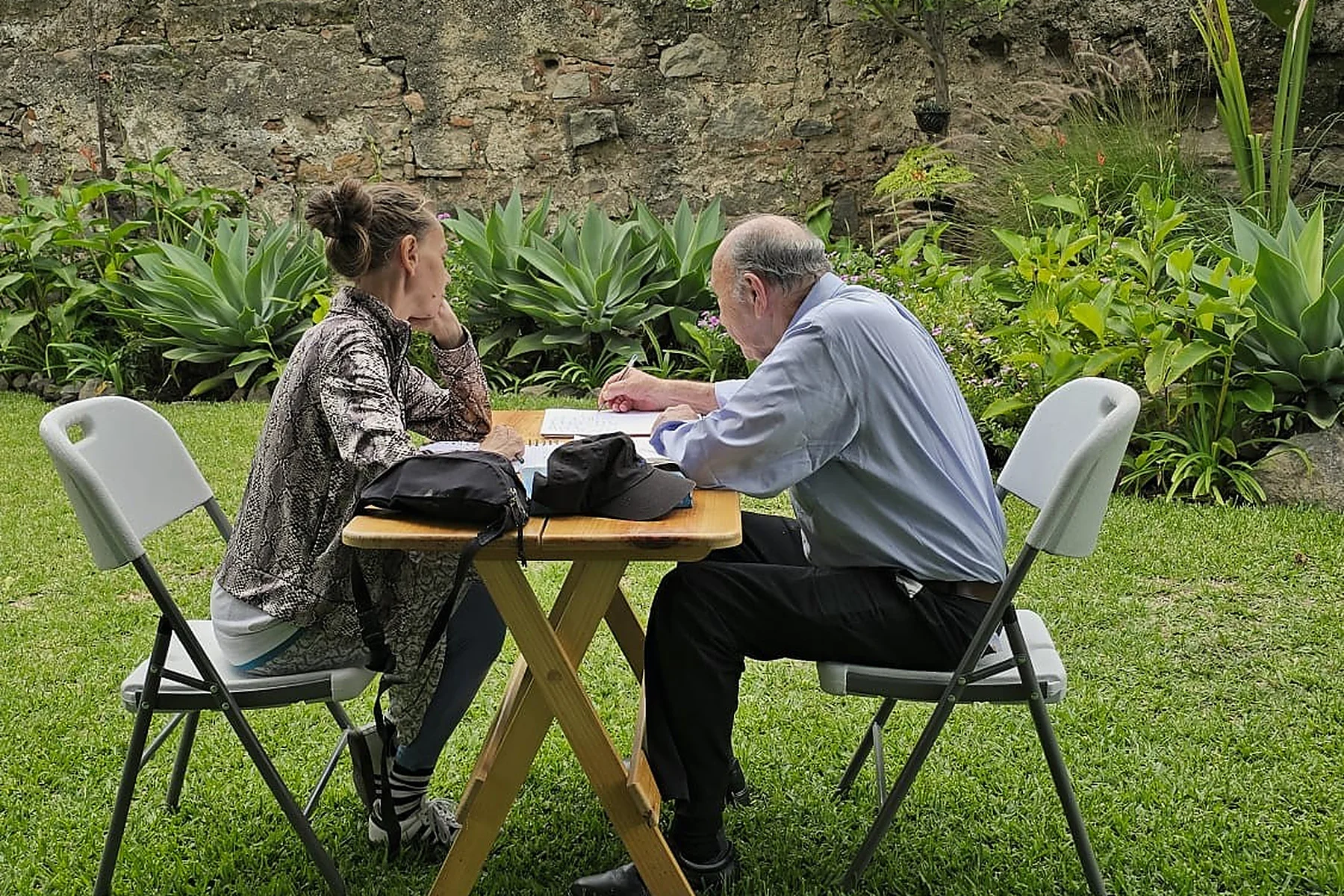
Our regular classes are private, one-on-one lessons adapted to each student's level, interests, and learning objectives.
From the earliest levels, students work with practical dialogues, useful vocabulary, pronunciation, listening comprehension, and grammar applied to real situations.
Written exercises complement oral practice, helping students reinforce what they learn.
The goal is not to teach expressions that only work in Guatemala. Instead, we help students develop the skills to communicate with Spanish speakers from different countries while recognizing the pronunciation and expressions they encounter locally.
Outside the classroom, cultural activities offer additional opportunities to practice.
A conversation at a café, a visit to a market, or an interaction with a host family can turn classroom vocabulary into meaningful communication.
Students may also combine their lessons with a homestay or continue their Spanish studies online before or after visiting Guatemala.
Whether your goal is travel, personal enrichment, professional communication, or connecting with Spanish-speaking family and friends, the learning experience can be adapted to your needs.
Will Spanish Learned in Guatemala Work in Other Countries?
Absolutely.
The fundamental grammar, essential vocabulary, and communication skills you develop in Guatemala are applicable throughout the Spanish-speaking world.
You may hear different accents in Spain, encounter unfamiliar expressions in Argentina, or discover new everyday words in Mexico.
But understanding regional differences is part of becoming a more capable language learner.
A student who can ask questions, share experiences, express opinions, and participate in conversations has skills that extend well beyond a single country.
The goal is not to sound exactly like every Spanish speaker. It is to develop the confidence and flexibility to communicate with different people.
**One language, many voices—and countless opportunities to connect.**
At Spanish Antigua, we have been helping students discover Spanish through personalized lessons and cultural experiences since 1978.
Your journey can begin in Antigua and continue wherever Spanish takes you.
Explore our private Spanish programs at https://spanishantigua.com/programs and discover how you can begin learning Spanish in Guatemala.
Sources & Further Reading
This article draws on linguistic research and publications from academic institutions specializing in Spanish and its regional varieties.
**1. Utgård, Katrine.** *La pronunciación del español guatemalteco: Atlas lingüístico-etnográfico de Guatemala. Nivel fonético segmental. Análisis geolingüístico pluridimensional.*
A study examining regional pronunciation patterns across 22 locations in Guatemala.
https://www.researchgate.net/publication/263364014_-La_pronunciacion_del_espanol_guatemalteco-_Atlas_linguistico-etnografico_de_Guatemala_Nivel_fonetico_segmental_Analisis_geolinguistico_pluridimensional
**2. Real Academia Española (RAE) and ASALE.** *El seseo y el ceceo.*
An explanation of regional pronunciation differences in the Spanish-speaking world.
https://www.rae.es/buen-uso-espa%C3%B1ol/el-seseo-y-el-ceceo
**3. Real Academia Española (RAE) and ASALE.** *Voseo — Diccionario panhispánico de dudas.*
A reference explaining the use of *vos*, including its presence in Guatemala.
https://www.rae.es/dpd/voseo
**4. García, Ana Isabel.** *Contacto de lenguas en Guatemala: cambios en el sistema pronominal átono del español por contacto con la lengua maya tzutujil.* Tópicos del Seminario, no. 15 (2006), pp. 11–71.
Research examining language contact between Spanish and Tz'utujil in Guatemala.
https://doi.org/10.35494/topsem.2006.1.15.178
**5. Asociación de Academias de la Lengua Española (ASALE).** *Diccionario de americanismos.*
A reference for regional vocabulary and expressions used in Guatemala and other Spanish-speaking countries.
https://www.asale.org/damer/